
Holiday Pause
Sophie Agnel, Christian Marien Quartett, Saviet/Houston Duo, Schnell

There’s another packed week of music in Berlin, leaning right up to Christmas. The recommended shows list below is extended, running through January 5, allowing me to step away from the newsletter for a couple of weeks. I’m proud of what this little thing has accomplished in a couple of years and I’m quite shocked that I’ve managed to be so consistent. I hope reader feel the same way, and while I’ve resisted erecting a paywall, that doesn’t mean it isn’t appreciated when readers show a little financial support for efforts that occupy a good chunk of my time, week after week. I’ll be back in the new year with the usual rundown of my favorite albums of 2025. Until then, here’s a restful, peaceful holidays. Also, last Tuesday I joined Nate Chinen, Ayana Contreras, and Martin Johnson in a wide-ranging discussion on the year in jazz. If you’d like to check it out the link is behind a paywall at Chinen’s substack The Gig, but Nate tells me that readers can access it with a one-time code that there will be an option for.
Berlin Comes Together for Sophie Agnel
As I’ve noted several times in this newsletter, I only belatedly awoke to the brilliance of French pianist Sophie Agnel, an improviser of astonishing clarity and originality, in the last couple of years. In fact, I feel like I haven’t been alone in celebrating her music. My own shortcoming aside, it felt like she has been breaking through to new listeners—last year Chicago cornetist Ben LaMar Gay enlisted her talents for a new commission presented at Pierre Boulez Saal—and a wide swath of recordings, both solo and in duos with artists as disparate as percussionist Michael Zerang, turntablist Joke Lanz, and sound artist Jérôme Noetinger, have showcased her range, sense of purpose, and steely determination.
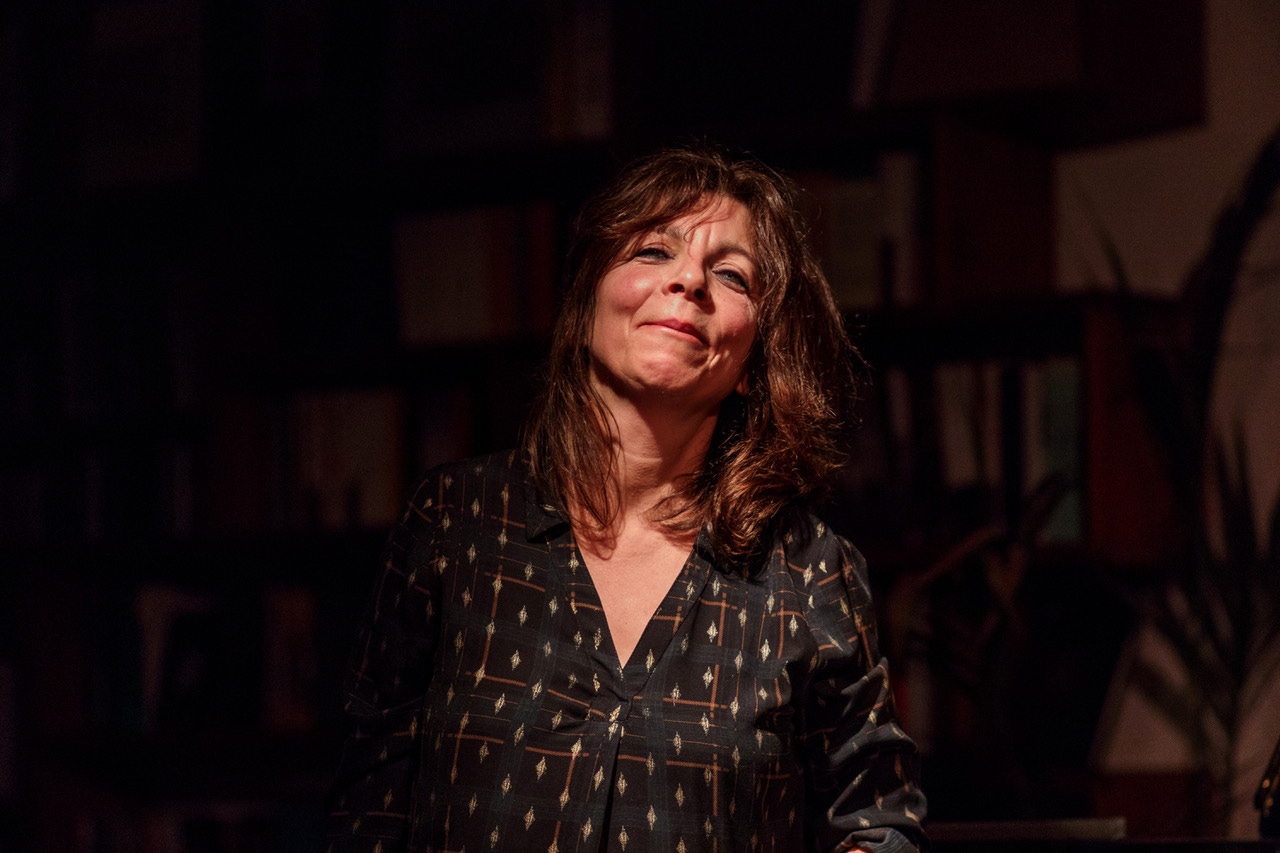
That rising acclaim and visibility only made a brain cancer diagnosis this summer all the more awful. It was the reason she had to cancel a scheduled Berlin concert with John Edwards and Steve Noble at Exploratorium in July, as she had undergone surgery in June. Noetinger established a website to help defray the pianist’s expenses—although insured, her inability to work as she recovers, including a month at a rehabilitation center, has been steep. Finally, a couple of weeks ago, Agnel returned home. Naturally, her energy level is diminished and she still requires assistance, but I was incredibly happy to see that Agnel is scheduled to perform with violinist gabby fluke-mogul on February 3 at the Sons D’Hiver Festival in Paris, sharing the bill with Thumbscrew. I imagine her return to performaning will be gradual, but even this bit of news is very encouraging.
Despite the health issues, Agnel’s music continues to make waves and she’s bookended 2025 with two incredible solo albums. In March she released Song (Relative Pitch), which was recorded in two sessions in 2022 and 2024, with a clear focus on her left-handed intensity. Early on I found those bass-heavy meditations a bit too much, but as I gained a fuller appreciation for her playing I realized that the viscous, dense clouds of overtones such gestures produced was a central part of her aesthetic. There seems to be an explosion of female pianists in Europe blazing new trails with prepared piano including Magda Mayas, Marina Džukljev, Marta Warelis, Ingrid Schmoliner, and Lisa Ullén, to say nothing of New Zealander Hermione Johnson, but Agnel has been expanding her sound world by getting under the hood of her instrument for decades, using preparations or activating and hammer strings with various objects. Depending on the piece we enter a world of thundering intensity full of dark, roiling patterns, or we tip-toe into a deliciously delicate environment flush with tactility. In each of the seven pieces she sculpts a specific pathway, sometimes focusing on a single gestural activity, like the lower register churn of “Song 1” or the contrapuntal action on “Song 4,” where she not only throws upper-register sallies and fragments at her left-handed thrumming, but elsewhere she fires off unpitched percussive runs. It’s a knockout you can hear below. The opening and closing pieces featured a single, eerily beautiful French folk song seeping into the sound field, more sonic scrim than duo partner.
More recently another mind-blowing solo album called Learning (Otoroku) was released, capturing a couple of pieces recorded live at London’s Café Oto in 2023 and 2024. Unlike the more single-minded excursions on Song, these two pieces reflect how the pianist deftly weaves all of these disparate ideas together live, an endless flow of gestures, riffs, noises, and resonances that proceed according to a logic that’s all her own. As you can hear below on “Learning A,” her two hands are in constant motion, pitting ever-shifting actions against one another: airy chordal stabs clobbered by bass-heavy thuds, metallic plucks and sweeps inside the instrument dancing with heavily damped arpeggios, and glissed string rubbing abraded by percussive lines banged out on the instrument’s wooden body. There’s a lot more than that, but you get the idea, especially if you listen to the damn thing. As Agnel recuperates, a distinguished crew of Berlin musicians are performing Friday, December 19 at KM28 to raise funds for the pianist: click that link for the star-studded lineup.
Christian Marien’s Quartett Meets the Minutes
For its superb new album Beyond the Fingertips (MarMade) the Christian Marien Quartett recorded direct to disc, spreading music across two sides of lacquer that can each accommodate 18 minutes of sound. The decision to embrace such antiquated, purely analog technology imposed limitations beyond time constraints. The band couldn’t stop-and-start or take pauses between takes, which made the recording experience rather close to a live performance, warts and all. Additionally, the drummer wanted to record the band’s new book of tunes, so each performance had to be succinct, and cramming in eight tunes in the space of 33 minutes feels closer to a pop music practice than any jazz endeavor in the last 75 years, when the LP allowed for performances longer than the three minutes a 78 RPM disc could handle. When you’ve got a band featuring reedist Tobias Delius, bassist Antonio Borghini, and guitarist Jasper Stadhouders it can seem like a head-scratching decision, since allowing this quartet to stretch out is a very good idea.
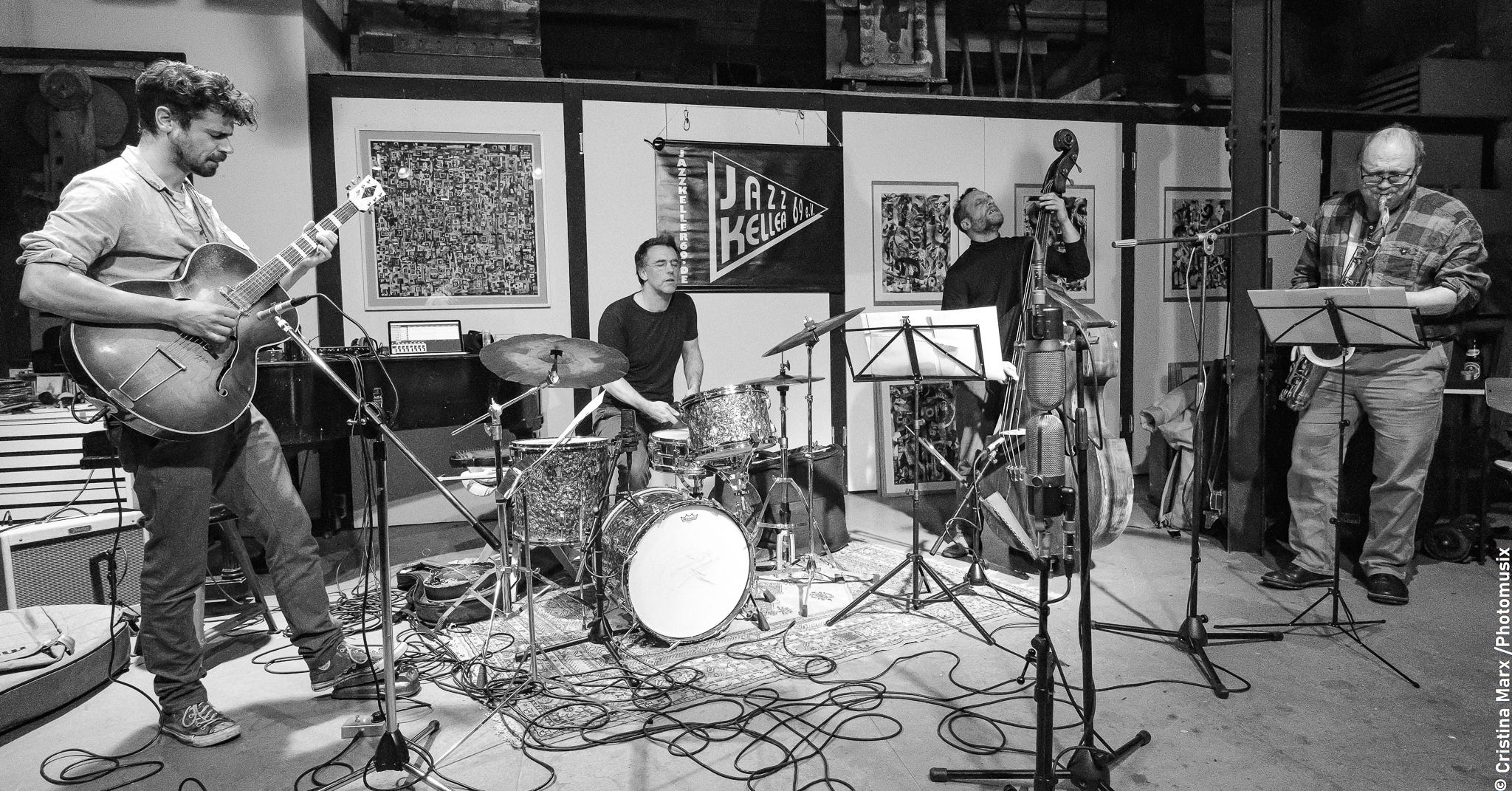
But the results certainly vindicate Marien, as the music unfurls at maximum efficiency without ever sounding forced, truncated, or uptight. I went back to re-listened to the group’s 2024 debut How Long is Now, and it holds up wonderfully, flush with indelible melodies, flinty grooves, and stellar ensemble rapport. The new album is even better, its tunes thriving in the pared down context. The band is at once loose and rigorous, inhabiting the leader’s catchy, buoyant tunes, and the judicious space allotted for improvisation is expertly deployed, flowing with the natural logic a real working band achieves, even if this quartet, sadly, doesn’t work that much. The tunes flow right into each other, a suite-like construction that the band nails without hiccuping. The actual release doesn’t divide up those side-long performances either, so below you can hear the entirety of side 1 below,, “Love All. Play! / Martha / Blues in Aspik / Cordinale.” Marien’s sharp sequencing moves through an ebullient, skittering groove, a chattery, probing ballad, a loose-goosey, needling post-bop ditty with effortless back-and-forth between Delius and Stadhouders, all winding down in an abstract, collectively formed meditation. Regular readers surely know of my unbound admiration for Delius and Borghini, but the big takeaway for me is that his combo is that it’s surely the best vehicle for Stadhouders I’ve ever heard, giving him the space to play pithy, melodic lines, blasts of gunky guitar noise, off-kilter phrases, and straight-up, clean-toned comping. It’s a real band with a shared sense of purpose. The Marien Quartett celebrates the release of the new album with a performance on Tuesday, December 17 at Kuhlspot.
The Saviet/Houston Duo Make Music in 360º
A few weeks ago at the Huddersfield Contemporary Music Festival I got to hear the stunning second performance of Blue Hour, an audacious new 90-minute work for piano and violin by Sarah Hennies. The stately, durational work extends a sequence of melodic phrases and gestures through repetition and microscopic variation, pulling the listener in and warping any sense of time. The work requires precise execution and laser-sharp focus, qualities that pianist Joseph Houston and violinist Sarah Saviet, for whom it was written, possess in abundance. The two Berlin-based musicians are among the most important, versatile, and curious figures in contemporary music, and when they join forces and aesthetic concerns their power seems to expand exponentially. Since forming in 2019 the duo has tackled a wide range of work, but its sweet spot has been interpreting music written by friends and contemporaries as well as composing their own work. I remain a huge fan of the duo’s 2024 album a clearing (Marginal Frequency), which focused exclusively on its own writing, and as I wrote last year, “It’s only natural that instrumental masters possess rarefied knowledge that can be tapped for compositional pursuits, not merely as areas of exploration and experimentation, but as inextricably linked threads that can open up written material well beyond schematics.”
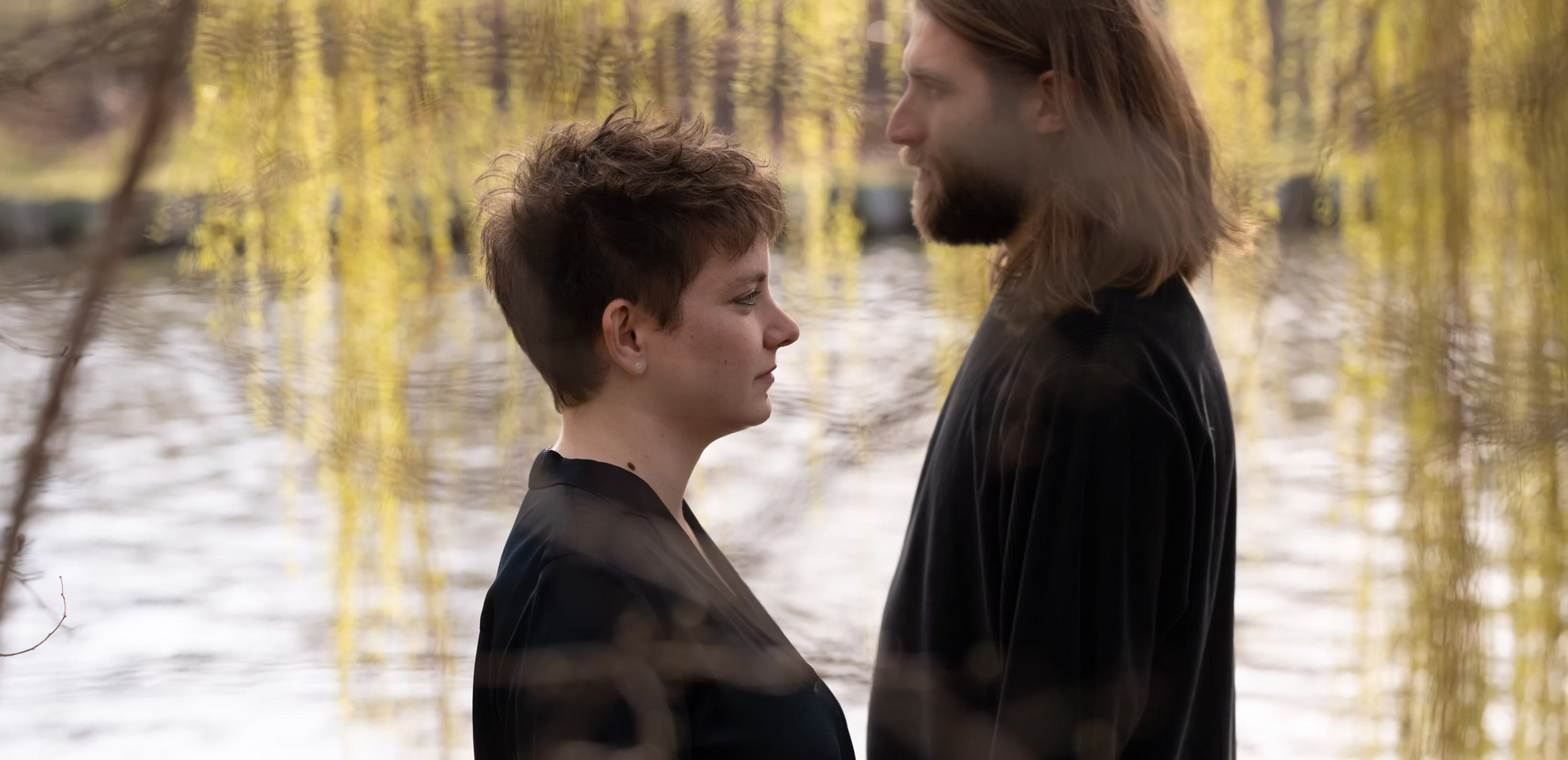
The duo released its second album Lines We Gather (Winter & Winter) this past fall, presenting music written over a 46-year span, reaching back to Xenakis piece “Dikhthas” and concluding with a new work of their own and “Are you there,” a fresh gem by British composer Lawrence Dunn. The repertoire helps illustrate the pair’s sound world, beginning with an account of Michael Finnissy’s “Mississippi Hornpipes,” a 1982 piece derived from traditional folk fiddle tunes from America’s deep south that juggles various themes, with the musicians coming together and pulling apart to the point of collapse, a drunken dance of sobering virtuosity. On Dunn’s piece an endlessly meandering but stately, attractive melody voiced by Saviet, and shaded by single piano notes, wends its way through Houston’s gently plodding frame, with the composer using an octave between the pitches to symbolize a simultaneous connectedness and distance. What seems relatively simple at first blush accrues weight over time, as the line starts to precipitate a certain restlessness, until Houston takes key melodic duties and Saviet offers complementary accents, swells, and unisons in the background. The piece then races through shifting episodes, juggling scales, hammering ostinatos, and crushing density until a jaunty song-like passage closes things down. Even more bruising and breathless is the duo’s account of “Dikhthas,” a whirling dervish of intersecting lines and barely contained energy. The album concludes with “Taste,” the upshot of Rebecca Saunders and Enno Poppe’s halting desire to compose a piece together, leading to this fusion of two older solo pieces—the former’s solo piano work “Shadow” and the latter’s solo violin composition “Schmalz”—for which they each wrote a second line in one another’s piece.
But I think my favorite piece on the album is the duo’s own “Walking, Waking,” which carries on the sort of music on a clearing. A simple unison line unfolds over the course of nearly 12 minutes, with terse gestures and tangled, yet elegant thickets of sound complicating the procedure. As the piece proceeds it blossoms with several minutes of molasses-slow long tones, opening up radiant harmonies. They’ll perform the piece as part of a dazzling program at KM28 on Tuesday, December 17, which you can hear below, along with the world premiere of a new piece written for the duo by Chiyoko Slavnics and Zeynep Toraman’s gorgeously hypnotic “Album for the Young,” on which Houston plays synthesizers.
Schnell Speeds Back into Berlin
This week the high-octane trio called Schnell reunites for a couple of rare Berlin performances on Wednesday and Thursday, December 17 and 18 at Sowieso, the site where the group recorded its fantastic 2018 on Clean Feed. When they recorded the album in 2017 the brilliant French alto saxophonist Pierre Borel was still living in Berlin, and alongside double bassist Antonio Borghini and drummer Christian Lillinger they forged a mind-melting iteration of modern bebop, enfolding blinding speed and incremental change to create something thoroughly contemporary. The music on the album swings like mad, with Borel pushing the motivic genius of Sonny Rollins to the hilt. He’ll take a terse flurry of sixteenth-notes and work it over like a pile of dough, kneading, stretching, recombining, and flattening phrases with breathless rigor. They fully run though the Billy Strayhorn ballad “A Flower is a Lovesome Thing,” but trademark bebop licks fly all over the place, even if only one of tracks makes any reference to the quotation fest happening, the wryly named “Shaw no evidence of dr. J,” where the oblique references to Dizzy and Monk are made palpable. Hearing these musicians rip through bebop tropes at blazing speed is pleasure enough, but that fluency of language is merely a tool for the trio’s interest in developing minimalist gestures and phrases over time. Usually minimalism occurs at a very slow place, making it easier for a listener to track changes. With Schell (the German word for “fast”) the tempo is so furious that we need to acclimate ourselves to that before we begin recognizing how the material is transformed over time. There are parts of Borel’s playing here that reflect some of the stubborn alto saxophone patterns Seymour Wright locks in with in [Ahmed], but those cranky honks are just part of a larger fabric for Borel, who toggles between phrases like a DJ juggling beats. Below you can check out “Schnell II.”
Recommended Shows in Berlin Through January 5
December 16: Saviet/Houston Duo (Joseph Houston, piano, and Sarah Saviet, violin) play music by Saviet/Houston, Chiyoko Slavnics, and Zeynep Toraman, 8:30 PM, KM28, Karl Marx Straße 28, 12043 Berlin
December 16: Christian Marien Quartet (Tobias Delius, tenor saxophone, clarinet, Jasper Stadhouders, guitar, Antonio Borghini, double bass, and Christian Marien, drums), 8:30 PM, Kühlspot Social Club, Lehderstrasse 74-79, 13086 Berlin
December 17: Schnell (Pierre Borel, alto saxophone, Antonio Borghini, double bass, and Christian Lillinger, drums), 8:30 PM, Sowieso, Weisestraße 24, 12049 Berlin
December 17: Lange//Berweck//Lorenz (Silke Lange, Sebastian Berweck, and Martin Lorenz, synthesizers) play Eloain Lovis Hübner, Lula Romero, Florian Zwißler, Ernstalbrecht Stiebler, and Asmus Tietchens, 8 PM, Theater im Delphi, Gustav-Adolf-Strasse2 2, 13086, Berlin
December 17: Brom (Alexander Beierbach, tenor and soprano saxophone, Jan Roder, double bass, and Christian Marien, drums), 8:30 PM, Panda Theater, Knaackstraße 97, (i.d. Kulturbrauerei, Gebäude 8) 10435, Berlin
December 18: Schnell (Pierre Borel, alto saxophone, Antonio Borghini, double bass, and Christian Lillinger, drums), 8:30 PM, Sowieso, Weisestraße 24, 12049 Berlin
December 18: Jane in Ether (Miako Klein, recorders, Paetzold, Biliana Voutchkova, violin, voice, and Magda Mayas, piano), 8:30 PM, Kühlspot Social Club, Lehderstrasse 74-79, 13086 Berlin
December 19: Concert for Sophie Agnel with Tony Buck, drums, Joke Lanz, turntables, and Magda Mayas, piano; Lucio Capece, bass clarinet, mini speakers, Xavier Lopez, piano, and Deborah Walker, cello; Jasmine Guffond, electronics, and Kai Fagaschinski, clarinet; Axel Dörner, trumpet, Annette Krebs, Konstruktion #4), Andrea Neumann, inside piano, mixer, and Michael Renkel, guitar, 7:30 PM, KM28, Karl Marx Straße 28, 12043 Berlin
December 19: Soko Steidle with Alexander Von Schlippenbach (Rudi Mahall, bass clarinet, Henrik Walsdorff, alto saxophone, Jan Roder, double bass, Oliver Steidle, drums, percussion, and Alexander Von Schlippenbach, piano), 8:30 PM, 8:30 PM, Sowieso, Weisestraße 24, 12049 Berlin
December 20: Roger Kintopf’s Cipher (Kirke Karja, piano, Felix Hauptmann, synthesizer, Roger Kintopf, bass, and Philip Dornbusch, drums), 8:30 PM, Donau115, Donaustraße 115, 12043 Berlin
December 20: Erasao Septet (Mariá Portugal, drums, percussion, Angelika Niescier alto saxophone, Lotte Anker, saxophoes, Matthias Müller, trombone, Moritz Wesp trombone, Carl Ludwig Hübsch, tuba, and Reza Askari, double bass, 8:30 PM, KM28, Karl Marx Straße 28, 12043 Berlin
December 27: Soko Steidle (Rudi Mahall, bass clarinet, Henrik Walsdorff, alto saxophone, Jan Roder, double bass, and Oliver Steidle, drums, percussion), 8:30 PM, Peppi Guggenheim, Weichselstrasse 7, 12043 Berlin
January 2: Ignaz Schick, alto saxophone, Christian Kühn, electric guitar, and Martial Frenzel, drums, 8:30 PM, Peppi Guggenheim, Weichselstrasse 7, 12043 Berlin
January 3: Faces & Places (Michaël Attias, alto saxophone, Florian Müller, guitar, Jonas Westergaard, double bass, and Oli Steidle, drums), 8:30 PM, Donau115, Donaustraße 115, 12043 Berlin
January 4: Bruchgold und Koralle (Jörg Hochapfel, piano, guitar, melodica, Johannes Schleiermacher, tenor and baritone saxophone, flute, James Banner, double bass, electric bass, and Max Andrzejewski, drums, glockenspiel, whistle), 3:30 PM, Industriesalon Schöneweide, Reinbeckstraße 10, 12459 Berlin