
Ground Down But Not Out
Seamus Cater & Fredrik Rasten, Dahl/Dalen/Søvik

Seamus Cater & Fredrik Rasten: Folk Music From a Different Realm
I don’t know a whole lot about the British musician Seamus Cater, who’s lived in Amsterdam since 2000, where he’s long explored twinned interests in experimental minimalism and folk in shifting proportions and styles. I believe I first saw him perform in Berlin on a program at KM28 organized by the International Nothing around the time he and Kai Fagaschinski released their peculiar duo album Secrets, where Cater plays concertina, harmonica, a touch of Fender Rhodes, and sings, both on reductionist pieces and fragile tunes. But I honestly didn’t really clock his contributions or his larger body of work until much later. A few years ago Another Timbre released his album A History of Musical Pitch, which further illuminated his disparate interests with a post-Wandelweiser speculative music that tried to imagine what it might sound like if the British mathematician Alexander J. Ellis—who conducted important research into pitch, using tuning forks and oddly tuned concertinas—would sound like. As far as I can tell, Cater is an intellectually curious thinker, an artist who eschews any divide between tradition, science, and experimentation.
He’s performing this Saturday, February 14 at KM28 with Berlin-based guitarist and singer Fredrik Rasten, playing music from their gorgeous new album Strange the Grass Grows (Anecdotal). The pairing makes plenty of sense, as Rasten has followed a similar path in braiding folk and experimentalism, particularly with his recent work with Scottish singer Alasdair Roberts. (I’ve seen their excellent duo a couple of times, and I’m thrilled that they’re making their US debut as part of Frequency Festival in Chicago on February 28). On the new album they veer toward a more traditional approach, traversing three Scottish and British folk ballads and presenting three Cater originals in the same vein. Although both musicians have sung in previous efforts, this new project puts the focus squarely on that practice, and their ability to harmonize together is stunning, their reedy voices coming together and pulling apart amid delicate fingerstyle guitar and concertina deployed in just intonation, which imparts a deeply resonant, almost glowing harmonic presence. It’s all quite subtle, and if you only listen to the way the voices of Cater and Rasten blend you might even miss it—but the full sonic spectrum is what distinguishes and, in certain ways, connects it to traditional practice.
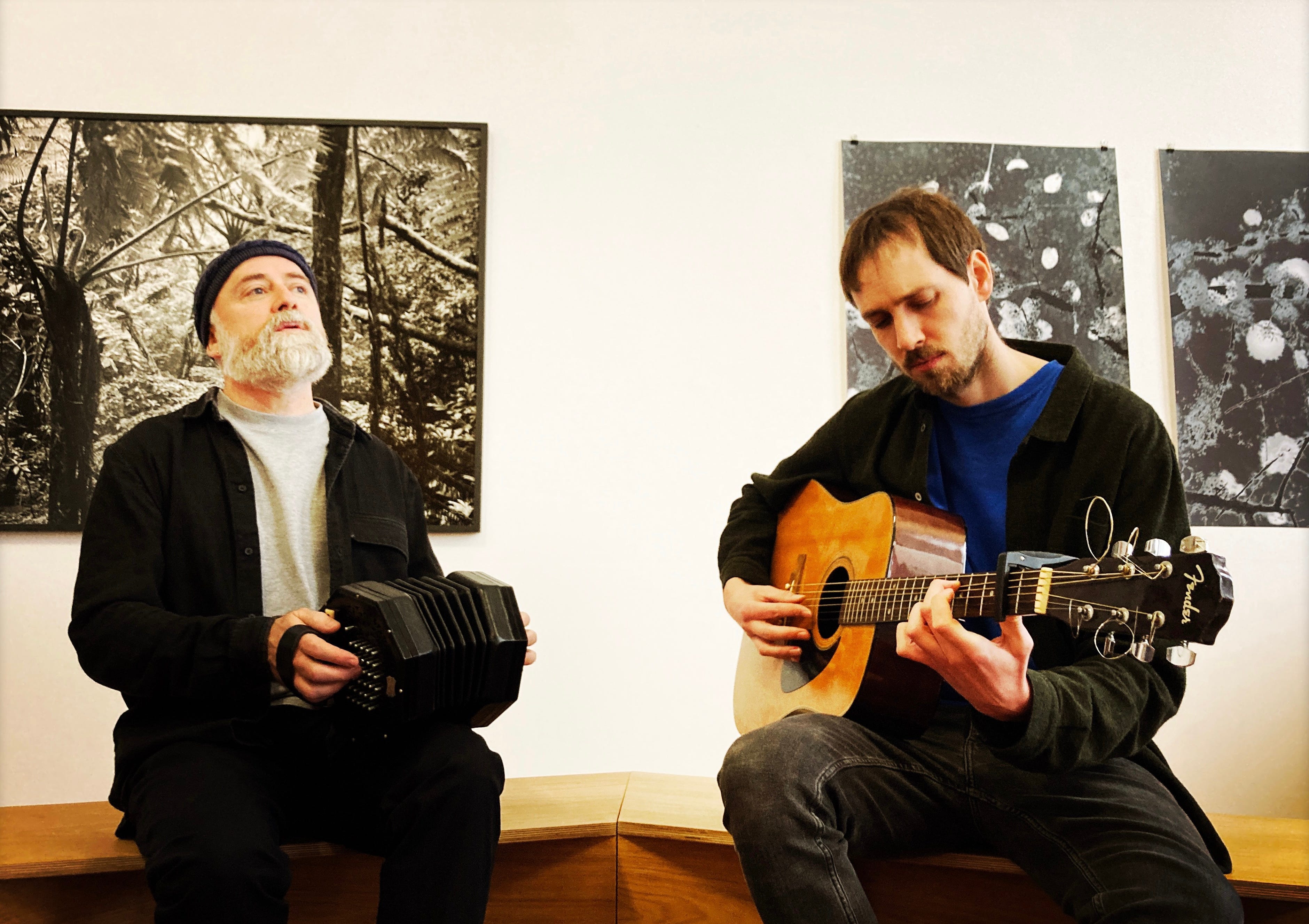
I adore the whole recording, but I’m particularly fond of Cater’s “Beowulf’s Arms,” with lyrics based on the 2000 Seamus Heaney translation of the Old English epic. In fact, all three of his songs draw directly from literary sources, whether its Olga Tokarczuk on the opening tune, or academic Daniel Heller-Roazen’s book The Fifth Hammer, Pythagoras and the Disharmony of the World on “For the Ear That is No More.” In “Beowulf’s Arms” Rasten plays cycling arpeggios as the pair harmonize, the guitarist delivering a surprisingly low, dry presence as Cater provides something more delicate and expressive in his higher pitch. Eventually he begins to trace the chord changes with warm, reedy long tones, which begin to radiate unusual harmonies as the performance unfolds. Gentle melodic variations creep in, with vocal lines that almost seem Beatlesque as the singers push their lines into an upper register. Cater injects a kind of staccato pulsation on his concertina in an extended instrumental section, concluding with a cycling melodic line accommodating new lyrics with each additional repetition. Check it out below. Although the album is pure balladry, unfolding with exquisite patience, each song contains nifty little flourishes or instrumental elements that set them apart, such as the slide guitar and wheezy bass harmonica on “For the Ear That is No More,” or the slow peal of trumpet on “Death and the Lady,” courtesy of Rasten’s partner in Pip and Oker, Torstein Lavik Larsen.
Amalie Dahl Slows it Down, Rips It Up
I just finished writing a profile of Danish saxophonist, composer, and bandleader Amalie Dahl, who lives in Oslo, so I’ve been spending a lot of time digging into her music over the last few weeks. Next month Sonic Transmissions will release Live at Moldejazz, the debut recording from her 12-piece ensemble Dafnie EXTENDED, which gave a triumphant performance at Jazzfest Berlin last fall. The project enlarges the wide stylistic berth previously explored by the quintet version of Dafnie, which has released two superb albums since 2022—a third, with guest pianist Lisa Ullén, is due this fall from Trost. Dahl is a remarkable musician with a deep curiosity, so no single project can contain all of her creative pursuits, although I suppose Dafnie comes closest. She returns to Berlin this week to play the Future Bash series at Neue Zukunft on Wednesday, February 11 with a tough collective improvising trio that traffics in muscular, wiry free jazz, featuring bassist Henrik Sandstad Dalen and drummer Jomar Jeppsson Søvik.
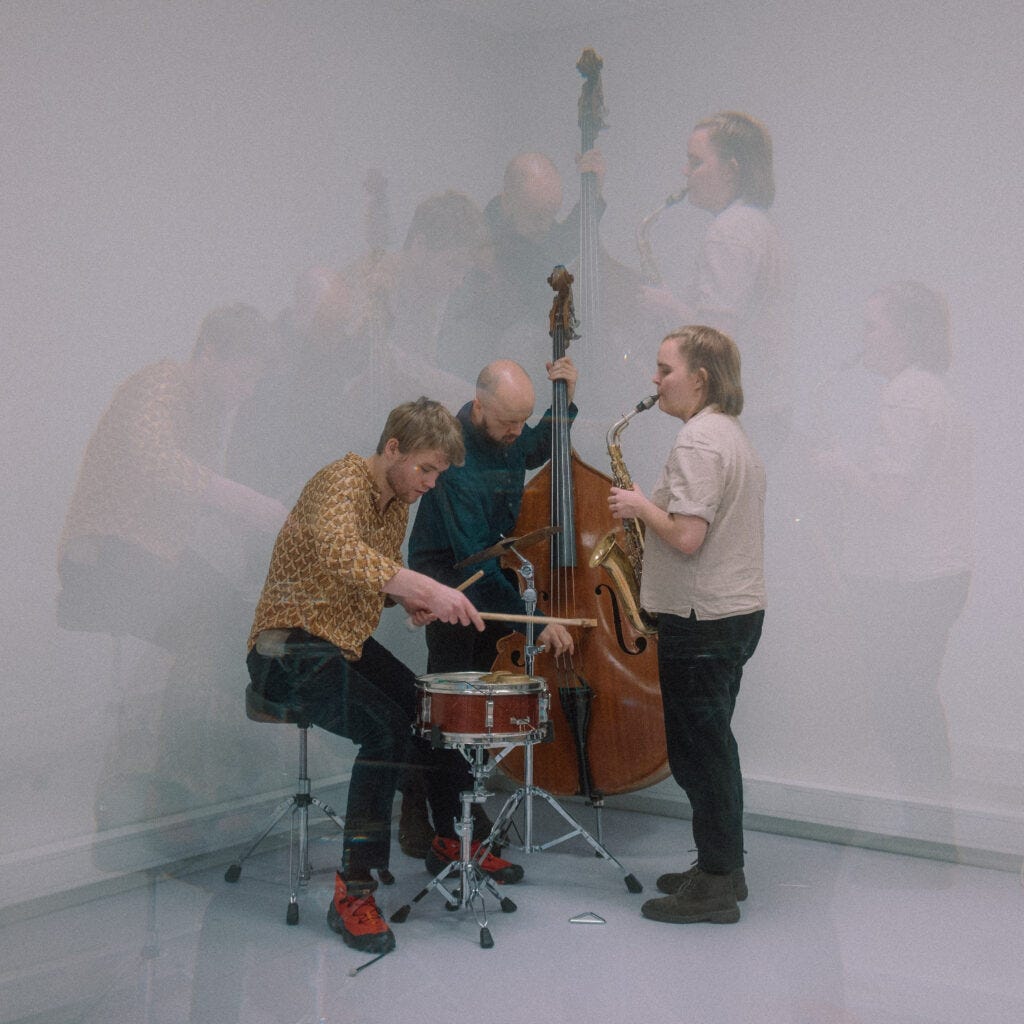
While the saxophonist can push all kinds of sonic extremes in terms of intensity, pitch, and attack, there’s something oddly measured about the group, at least as revealed on its most recent recording, a pair of live performances from Prague and Brussels in 2023 collected on Live in Europe (Nice Things). The Prague performance, a single, uninterrupted set you can hear below, proceeds at a leisurely pace even if the actual substance is anything but chill. Dahl screams, tongue slaps, unleashes unpitched breaths, and carves out flinty melodic lines, but she does so as if in slow motion, an attack shared by her bandmates. Most of the 43-minute set unfurls without haste, which flies in the face of free jazz orthodoxy, where tempo is usually aligned with intensity. By taking this approach we really get to parse what the trio does, whether it’s the viscous arco groans and febrile knottiness of Dalen or the kit-spread polyrhythms and clatter of Søvik, and how Dahl’s lilting, keening improvisation draped over the bumpy, halting rhythms.
Recommended Shows in Berlin This Week
February 11: Quatuor Diotima play Brahms, Zemlinsky, and Iannotta, 7:30 PM, Pierre Boulez Saal, Französische Straße 33d, 10117 Berlin
February 11: Adrian Sherwood, 8 PM, Metropol, Nollendorfpl. 5, 10777 Berlin
Febtuary 11: LAX (Henrik Walsdorff, tenor saxophone, Gerold Genßler, double bass, and Uli Jenneßen, drums), 8:30 PM, Panda Theater, Knaackstraße 97, (i.d. Kulturbrauerei, Gebäude 8) 10435, Berlin
February 11: Charlotte Greve, alto saxophone, voice; Constantin Krahmer Trio (Constantin Krahmer, piano, Dan-Peter Sundland, bass guitar; and Max Stadtfeld, drums) with Uli Kempendorff, tenor saxophone, 8:30 PM, Donau115, Donaustraße 115, 12043 Berlin
February 11: Amalie Dahl, alto saxophone, Henrik Sandstad Dalen, double bass, and Jomar Jeppsson Søvik, drums; Andrea Parkins, amplified objects, electronics, Valentin Gerhardus, piano, Felix Henkelhausen, double bass, and Marius Wankel, drums, 9 PM, Neue Zukunft, Alt-Stralau 68, 10245 Berlin
February 12: Marie Takahashi, viola, Michael Vorfeld, percussion, sound objects, and Matthias Müller, trombone, Spektral-Raumohr, Motzstraße 91, 10779 Berlin
February 13: Axel Dörner, trumpet, and Simon Rose, saxophones, World in a Room, Brunhildstraße 7, 10829 Berlin
February 13: Fare (Valentin Gerhardus, piano, electronics, Felix Henkelhausen, double bass, and Marius Wankel, drums), 8:30 PM, Donau115, Donaustraße 115, 12043 Berlin
Februar 14: Pit Stop (Marta Forsberg, synthesizer, violin, voice, and Steve Heather, drums, percussion, electronics), 4 PM, Satellit, Weinstraße 11, 10249 Berlin
February 14: Seamus Cater, voice, concertina, harmonica, and Fredrik Rasten, voice, guitar, 8:30 PM, KM28, Karl Marx Straße 28, 12043 Berlin
February 14: Marta Warelis, piano, and Dan Peter Sundland, electric bass, with Camilla Nebbia, tenor saxophone, and Steve Heather, drums, 8:30 PM, Sowieso, Weisestraße 24, 12049 Berlin
February 16: Fred Frith, guitar, voice, and Russudan Meipariani, piano, synthesizer, 8:30 PM, KM28, Karl Marx Straße 28, 12043 Berlin