
Coming Up Short
Emilio Gordoa, Ethiopiques

This week’s newsletter was considerably longer when I awoke this morning, but once I full awake I realized I had written about something a month from now. It will surface when the time is right, but in the meantime please enjoy this slightly truncated edition of Nowhere Street.
Emilio Gordoa Extends the Vibraphone
The Mexican percussionist Emilio Gordoa has become an integral part of Berlin’s improvised music community since settling in the city back in 2012, landing firmly within the echtzeitmusik world. I’ve heard him in various contexts, including his crucial role within Mariá Portugal’s stellar Erosão Percussion Trio, where along with Burkhard Beins he helps to sculpt a dazzling fabric of percussive sounds, both coloristic and rhythmic in shifting proportions. Last month his trio with trumpeter Axel Dörner and drummer Sunk Pöschl released Native Acts (Trouble in the East), a double CD of highly interactive improvisations where he threads an electro-acoustic minefield with subtle sound-processing interventions, although his primary tool is meticulously placing the cool glow of his vibraphone within the shape-shifting collective din.
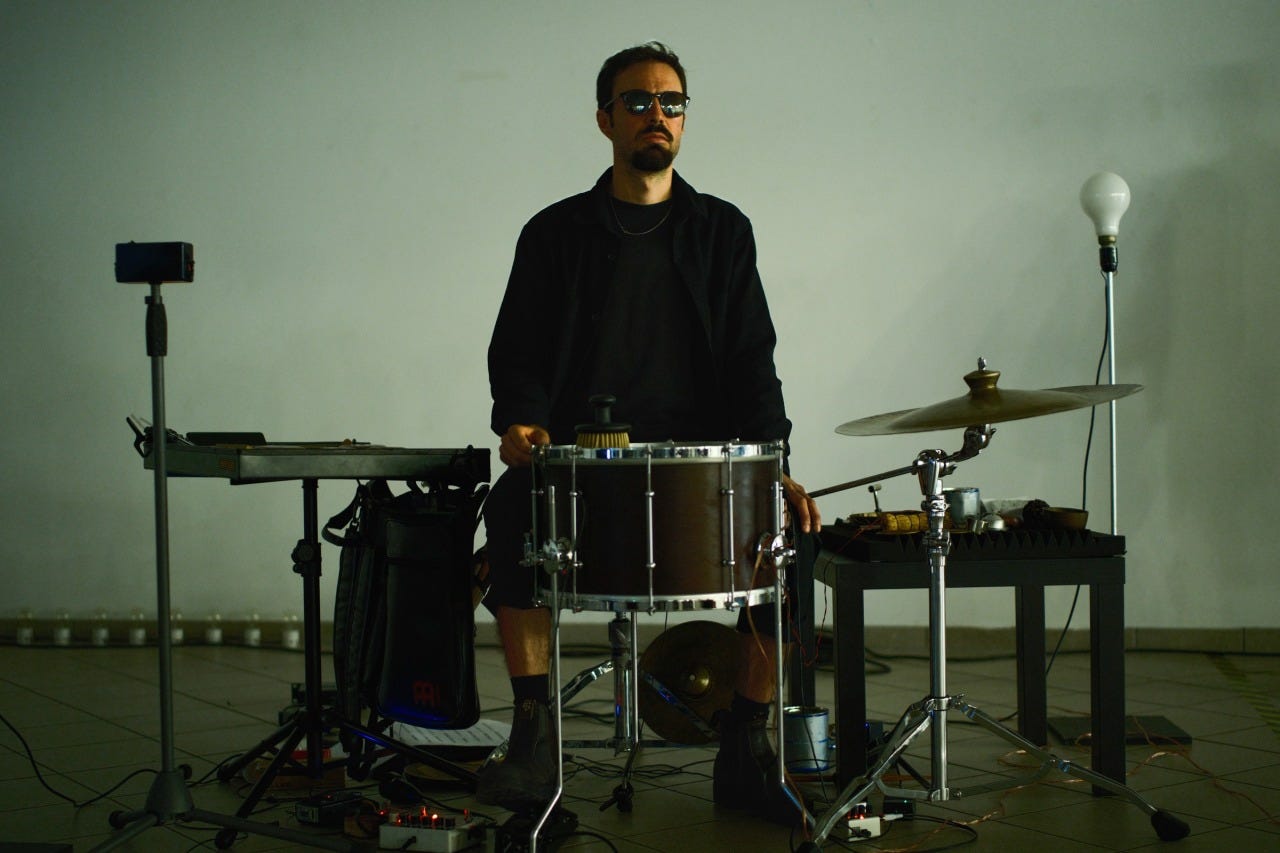
In recent weeks, though, I’ve been fully absorbed by Die Dritte Ebene (Ni Vu Ni Connu), a newly released album capturing a performance with the late Sven-Åke Johansson at KM28 back in August of 2023. It’s a recording that demands close listening to fully give up its hypnotic secrets. On first blush the proceedings are dominated by the trademark stutter patterns of Johansson—an endless spasm of acceleration and deceleration—which conveys endless propulsion and pulsation. The drummer entertains an inter-kit dialogue with surging cymbal sizzles offering commentary on the shifting tides of tom-tom and snare figurations. But soon the ebb-and-flow shimmer of Gordoa’s vibraphone chords emerges from the din, content to dwell in the background, but hardly sedentary or passive. In fact, Gordoa’s masterfully controlled coloring both places the drummer’s dance in relief and provides a kind of connective tissue that eventually reveals itself as half of the dialogue. The pair’s interaction isn’t obvious, but there’s no question that each musician becomes immersed within one another’s sound field, providing real-time energizing and shifting perspectives. Gordoa employs subtle electronic flourishes that extend and warp his sustained, glistening presence, holding steady and quietly injecting accents that allow Johansson the freedom to dance all around his kit. The drummer falls silent about 12 minutes in, ceding the space and placing the focus on Gordoa’s sonic fabric, and when Johansson starts back in the vibraphonist has begun to bow the bars of instrument before quickly pivoting to a series of sparse, vibrato-laden strikes that generate thick overtones, further enhanced and treated by electronic effects. You can hear the first part of the album below.
Gordoa delivers a masterful clinic in sound sculpting, transforming relatively simple notes into almost psychedelic waves of warped, oscillating tones. That brief pause by Johansson not only sets up a transformation, but gives just enough space for the listener to adjust their ears to the magic conjured by the vibraphonist. Eventually Gordoa glides into levitating arpeggios and cycling patterns, both holding their own against Johansson’s irascible, stubborn post-swing machination. All falls silent as Johansson picks up his accordion, building a reedy long tone into wheezing chords, which swell and fall into a mix of folksy and cabaret-grade licks, while Gordoa flips the script with strident bowing that pierces any sense of calm or clean denouement. It’s an incredible performance that pulls off a masterful sleight of hand with such minimal materials. I don’t know what Gordoa has up his sleeve for his solo performance at Sowieso on Saturday, March 28, sharing the bill with fellow percussionist Felipe Araya on the latest installment of Portugal’s Toma Chocolate series, but experience tells me he’ll transform whatever limited tools he has on hand into something remarkable.
The Welcome Return of Ethiopiques
Late last year I noticed that a pair of new titles emerged in the essential Ethiopiques series from Buda Records, the first in eight years. It was a wonderful surprise. I was immediately drawn to a new collection focusing on the singer Muluken Mèllèssè, whose feminine voice opened the very first Ethiopiques release back in 1999, when it was projected to be a ten-volume endeavor. He was only 17 when he cut those tracks. A couple of additional early tunes surfaced on two subsequent anthologies, but it took decades for the full reissue of his eponymous 1976 album with the Dahlak Band, one of the last vinyl releases in Ethiopia, to see release. By then the oppressive Derg was in the early stages of its brutal takeover, which among countless degradations, fully hollowed out a sophisticated, thriving music scene.
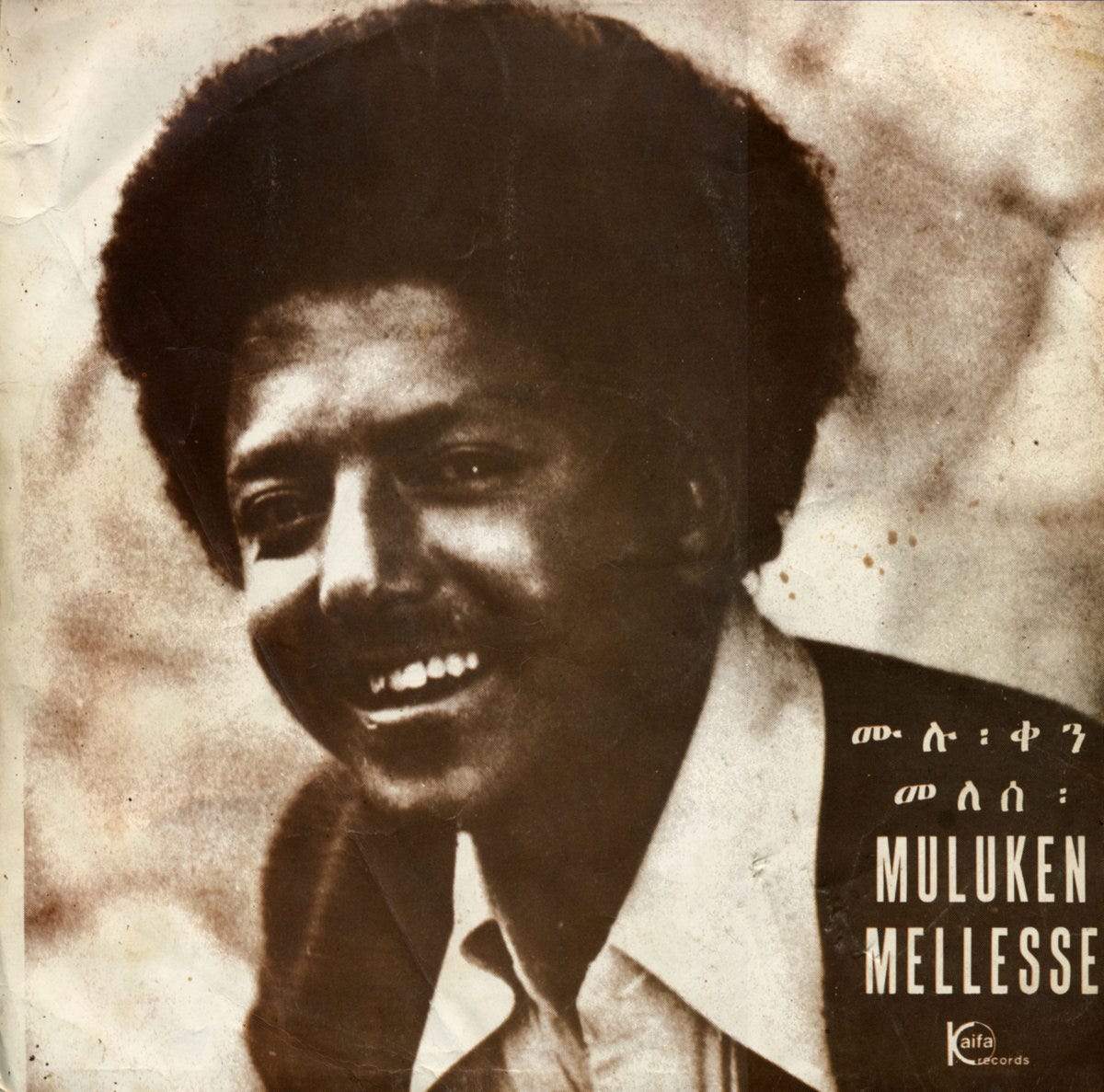
Mèllèssè got his start in the music business in the mid-1960s, starting out as a drummer before focusing on vocals, a wise choice as this CD makes plain. Between 1972-1984 he released eight 45s and eight full-length cassettes, but by 1980 he had converted to Pentecostalism, and was soon part of a major exodus of Ethiopian musicians to the US. In 1985 he stepped away from music for good. He died in 2024,at 70. The music on this collection is superb, Mèellèssè’s androgynous cry cutting sharply against the horn-stoked arrangements and limber, unstoppable grooves. If you’ve spent much time with this era of Ethiopian music you won’t be surprised, but you’re probably also hungry for more, and this title will do the trick. Below you can check out the burning opening track “Alagègnèhwatem,” a single recorded with the Venus Band in 1975, a year before he cut the album with the Dahlak Band. The tune is only included on the CD version of the album, which, oddly, isn’t accessible on the Bandcamp album page, so I’m including the link from an unrelated anthology. But it’s so good it warrants tracking down the CD version—Ethiopiques 31—which also includes three more tunes not on the vinyl reissue.
The second title is Nalbandian—The Ethiopian, a new recording featuring the Boston jazz ensemble Either/Orchestra, the long-running band led by reedist Russ Gershon. He became a major American advocate for vintage Ethiopian music in the late-90s, and the group’s 2000 album More Beautiful Than Death includes savvy arrangements of three Ethiopian gems, including the funk burner “Muziqawi Silt.” The release coincided with the emergence of the Ethiopiques series, initiated and still run by Frenchman Francis Falceto, and Gershon soon contacted the producer, beginning a long, deepening collaboration, recently detailed in this interview published by Post-Genre. Check it out for the full backstory, but suffice to say Either/Orchestra has remained interested in Ethiopian sounds, regularly including it in performances and eventually releasing a full recording Live in Addis, taped in the titular city in 2004 and performed with a slew of Ethiopian greats including Mulatu Astatke and Gétatchèw Mekurya.

This new project was designed to celebrate the work of Nerses Nalbandian, an Armenian who became a crucial architect of the modern Ethiopian sound through his writing and arranging as music director of the National Theater of Ethiopia in the 1950s and 1960s. Members of his family settled in Ethiopia in the mid-1920s, and it was his Uncle Kevork that paved the way for his nephew, with Nerses arriving in the
late 1930s. In the following decade he was appointed musical director of the Addis Ababa Municipality Band, and in the years that followed he was integral to the formation and development of the state-sponsored groups that emerged during the reign of Haile Selassie starting in 1955. These bands backed every major vocalist over the next three decades. Nalbdandian’s sensibility infused the more funk- and soul-influenced work that characterizes much of the best materials chronicled by the
Ethiopiques series, but he only waxed three tunes under his own name in 1967
and 1971. But charts of his pieces and concert recordings do exist, and Gerson set about using them to create a new book of Nalbandian arrangements, along with a few original tunes, as kind of repertory project, letting the listener get a sense of what it might have been like in the early days of Swingin’ Addis. There are a variety of guest vocalists spanning generations, whether Betty G, a pop singer in her 20s who knows these songs from her grandmother, and Girma Negash, a vet who actually sang with Nalbandian in the early 1960s. Either/Orchestra is a working jazz group using contemporary jazz language, so a lot of the solos erupt like blasts from the future. And Gershon doesn’t really seem capable of being a purist in regard to temporal authenticity—he’s too worked up by the material. Below you can hear the knockout opener, a Nalbandian composition called “Amhara Rumba,” which contains a series of fiery solos, including a tenor scorcher from Gershon and a buoyant clarinet improvisation by Hailey Niswanger.
The CD booklet includes Gershon’s narrative about the project, but Falceto’s essay about the Nalbandians is presented in French only, although an English translation is included on the album’s Bandcamp page, where he writes, “An entire book should be devoted to the life’s work of this veritable founding father who championed the causes of music in Ethiopia.” Based on the details he shares, that assertion isn’t the slightest
bit hyperbolic. In the booklet for the Mèllèssè is a short note that spells out the conclusion of the Ethiopiques series, listing four final, deeply enticing titles: a collection of 78 rpm shellacs from the 1930s, a second anthology from the sublime vocalist Tlahoun Gèssèssè with the Imperial Bodyguard Band, a reissue of the Mahmoud Ahmed album that was the last vinyl issued in Ethiopia, and a reissue of the Alemayehu Eshèté album that was the first cassette release produced in the country. Here’s hoping it doesn’t take eight years for them to surface.
Recommended Shows in Berlin This Week
March 24: Chris Brokaw, 8 PM, Privat Club, Skalitzer Straße 85-86, Berlin
March 25: Lament: a ritual of letting go (Juliet Fraser, soprano, Christelle Monney, mezzo-soprano, Sarah Saviet, violin, viola, Soosan Lolavar, santur, and Eliza McCarthy, keyboard, shruti box), 8 PM, MaerzMusik, Parochialkirche, Klosterstr. 67, 10179 Berlin
March 25: Megan Alice Clune, clarinet, voice, electronics; Judith Hamann, cello, electronics, 8:30 PM, KM28, Karl Marx Straße 28, 12043 Berlin
March 25: Bob Spice Quartet (Robert Würz, alto saxophone, Matthias Müller, trombone, Maike Hilbig, double bass, and Martial Frenzel, drums) with Jürgen Kupke, clarinet, 8:30 PM, Panda Theater, Knaackstraße 97, (i.d. Kulturbrauerei, Gebäude 8) 10435, Berlin
March 26: A Short Horse (Jessie Marino, fiddle, voice, Weston Olencki, trombone, voice, and Fredrik Rasten, guitars, voice), 8:30 PM, KM28, Karl Marx Straße 28, 12043 Berlin
March 26: Robyn Schulkowsky, tam tam, percussion, and the the Teichmann Brothers, live electronics, processing, live sampling, 8:30 PM, Morphine Raum, Köpenicker Straße 147, 10997 Berlin (Hinterhof 1. Etage)
March 27: Music for Commons Sensed++ (Jan St. Werner, electronics, Erwan Keravec, bagpipes, and Dirk Rothbrust, drums, play music by Jan St. Werner, Nicholas Morrish
and Wolfgang Mitterer), 7:30 PM, MaerzMusik, Radialsystem V, Holzmarktstrasse 33, 10243 Berlin
March 27: Julius Windisch, keyboards, Brad Henkel, trumpet, Liz Allbee, trumpet, Vinicius Cajado, double bass, and Marius Wankel, drums, 8:30 PM, Sowieso, Weisestraße 24, 12049 Berlin
March 28: Vanessa Porter, percussion, plays Samir Odeh-Tamimi’s Éndropía, 7 PM, MaerzMusik, Radialsystem V, Holzmarktstrasse 33, 10243 Berlin
March 28: Emilio Gordoa, percussion, electronics; Felipe Araya, cajones, electronics, Gordoa and Araya, percussion, electronics, 8:30 PM, Sowieso, Weisestraße 24, 12049 Berlin
March 29: Pierre-Laurent Aimard, piano, plays Bach’s Well-Tempered Clavier, 4 PM, Pierre Boulez Saal, Französische Straße 33d, 10117 Berlin
March 29: Jan St. Werner, electronics, and Louis Chude-Sokei, voice, perform No Nation Left But the Imagination, 8:30 PM, MaerzMusik, Radialsystem V, Holzmarktstrasse 33, 10243 Berlin
In the late 80s, just after Dr. Wax, I spent time on the phone with Francis in relation to a band I was managing at the time. Our conversation drifted to the wealth of the pre-Derg music of Ethiopia. I mentioned that I'd love to hear more keyboard-based music of that era (having heard and owned a slim number of cassette recordings from that time) and have since mentioned it a few more times. Too bad that the series is coming to a close. It's been such a rich cultural addition and I guess we'll have to wait longer for the light to shine on the keyboardists of that era.
Thanks Matt, this is really thorough. I really appreciate the suggested gigs in Berlin.